


Ready to see how a coordinated plan might fit your situation?
Get Your Retirement Paycheck MapReview our retirement planning process, how we coordinate withdrawals with taxes, Social Security, and Medicare, and what to expect when working together.
Who this article is for (and who it isn’t)
- This is for: Households approaching or in retirement with multiple accounts (401(k)/IRA, Roth, brokerage), planning to draw Social Security, and wanting a coordinated, tax-aware income plan.
- This is not for: People looking for stock tips, timing calls, or a one-size-fits-all “withdraw from this account first” rule. This is planning, not predictions.
What you might believe (and what might be missing)
- You might believe: “I’ll just take a little from each account each month.”
- What might be missing: In some situations, that approach may increase taxable income, affect the taxable portion of Social Security, or contribute to Medicare premium surcharges (IRMAA thresholds are updated annually and subject to change).
- You might believe: “Conventional wisdom says taxable first, then IRA, then Roth last.”
- What might be missing: That sequence may be simpler for some households. Others may find that a blended or year-by-year approach aligns better with current and expected tax brackets, RMD timing (currently age 73 for many; rules can change), and IRMAA thresholds.
The question you’re really asking “How do I turn different accounts into one paycheck without creating avoidable taxes, Medicare surprises, or running out too soon?”
Short answer
Order may matter as much as amount. A year-by-year, tax-aware blend across taxable, tax-deferred, and Roth—coordinated with Social Security—may help retirees more effectively manage after-tax income from the same assets under current rules.
Withdrawals are ordinary income and appear on your tax return. For many households, these balances are significant.
The three tax buckets (quick orientation)
- Tax-deferred: Traditional 401(k)/403(b)/IRA.
- Tax-free: Roth IRA/Roth 401(k). Qualified withdrawals are generally tax-free and typically don’t count toward Medicare IRMAA thresholds under current rules. Many retirees have limited Roth balances, which can reduce flexibility.
- Taxable: Brokerage/savings. Dividends and capital gains get taxed as incurred. You control when to realize gains, and long-term capital gains rates can be lower than ordinary rates.
When “taxable → IRA → Roth” makes sense (and when it may not)
- It can be simpler and may be fine when income stays consistent and RMDs won’t push you into higher brackets later.
- It may be suboptimal when:
- You have low-income years between retirement and first RMD (currently age 73 for many; rules can change) that could be used for partial IRA withdrawals or measured Roth conversions.
- You want to avoid increasing the taxable portion of Social Security (up to 85% may be taxable depending on combined income under current IRS rules).
- You are near Medicare IRMAA thresholds (updated annually; subject to change) and want to manage MAGI.
A practical, informational framework (how a paycheck can be structured)
- Step 1: Identify your income floor (Social Security, pension, existing annuity) and calculate the gap.
- Step 2: Map your current year’s marginal brackets, IRMAA thresholds, and how additional ordinary income or capital gains may interact under current rules.
- Step 3: Consider a blend across buckets to fill the gap. Examples:
- Lower-income/early-retirement year: Some households consider filling more from an IRA up to a target bracket and/or a measured Roth conversion, with taxable accounts supplementing as needed.
- Higher-income/after-RMD years: Some households consider using taxable and/or Roth assets to help manage additional ordinary income.
- Step 4: You may consider setting up automated monthly distributions so the checking account functions like a paycheck.
- Step 5: Midyear check: Many investors reassess if markets or income change.
Ready to see how a coordinated plan might fit your situation?
Get Your Retirement Paycheck MapReview our retirement planning process, how we coordinate withdrawals with taxes, Social Security, and Medicare, and what to expect when working together.
Social Security as part of the equation
- Timing: Delaying to age 70 may make sense for some households (longevity/survivor considerations), but it changes which accounts you may draw from during the delay period.
- Taxation: Up to 85% of benefits may be taxable depending on combined income under current IRS rules. Coordinating withdrawals with benefit timing can help manage this interaction.
What can go wrong without a plan (common considerations)
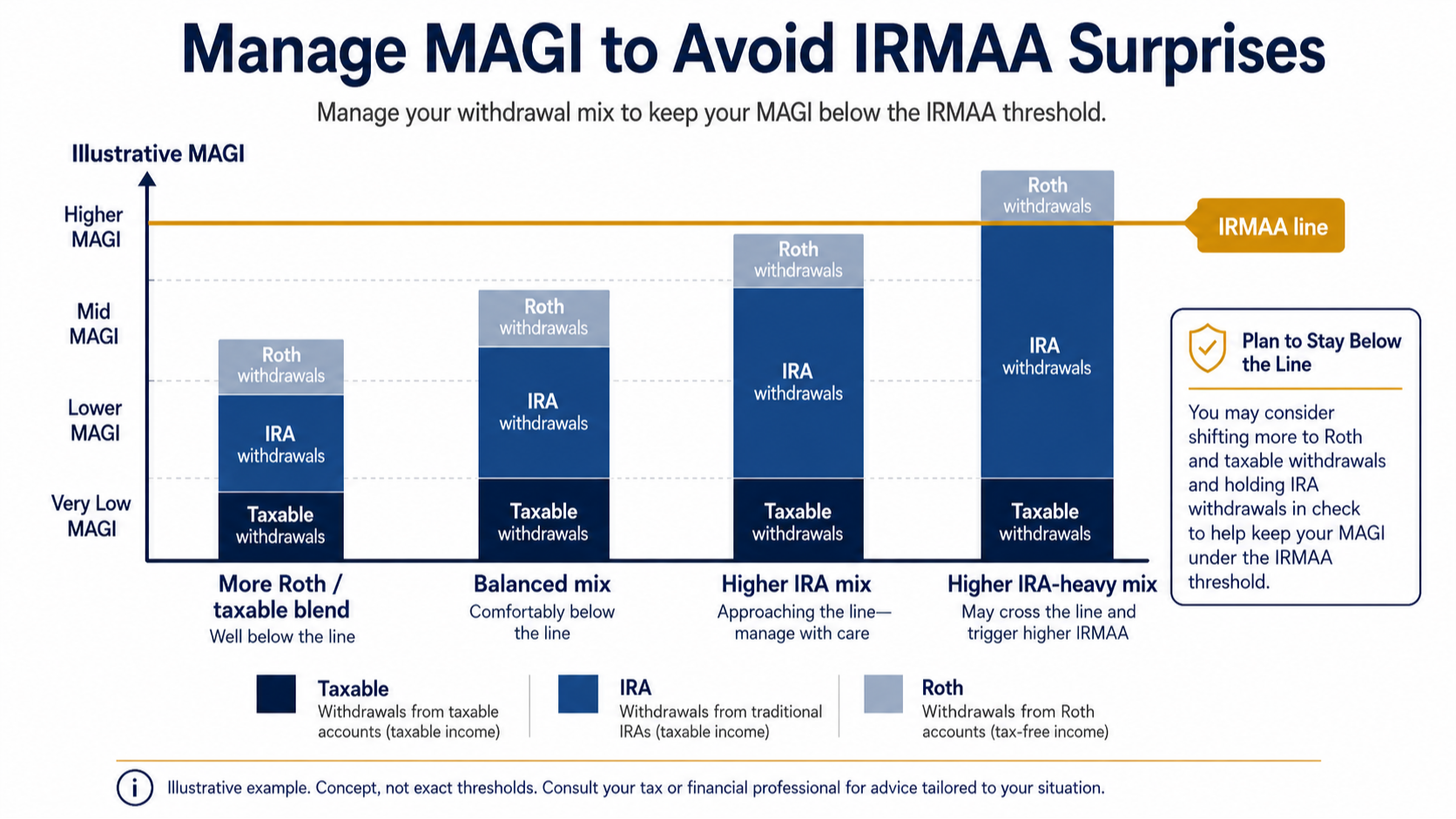
- One-account withdrawal: Relying primarily on a single IRA/401(k) may increase current-year taxable income, affect Social Security taxation, and contribute to Medicare IRMAA surcharges (thresholds updated annually; subject to change).
- No adjustments over time: The right mix at 63 may differ from the right mix at 73 (RMDs), 75 (second spouse claims Social Security), or 80 (healthcare costs evolve). Periodic review can help.
Preemptive answers to questions you likely have
- “Will I pay more tax if I convert to Roth?” Conversions create current-year taxable income. The analysis compares today’s known rate to likely future rates (post-RMD, survivor filing status, state taxes). The goal is to avoid “cheap today, expensive later.”
- “Can Roth withdrawals raise my Medicare premiums?” Under current rules, qualified Roth withdrawals typically do not count toward IRMAA thresholds. Rules can change.
- “What if markets are down when I need income?” Some households use a cash reserve or near-term bond sleeve to fund several months of income, then refill from whichever bucket is most tax-efficient that year.
- “What if I just annuitize and call it a day?” Simplicity may value for some. Others might prefer flexibility and legacy control. Trade-offs deserve a side-by-side look.
- “How often should this be reviewed?” Many review annually with a midyear check if income, markets, or tax rules shift.
- “What if my spouse outlives me?” Filing status often shifts to single, which may compress brackets and change IRMAA exposure. That’s one reason measured conversions before that transition can be considered.
Who typically benefits from this type of planning
- Often a fit if you:
- Are within 5 years of retirement or already retired
- Have multiple accounts (401(k)/IRA, Roth, brokerage) and may benefit from coordination
- Want an evidence-based, tax-aware withdrawal plan integrated with Social Security and Medicare considerations
- Not an ideal fit if you:
- Want stock picking or market timing
- Prefer a one-and-done plan with no annual review
- Are seeking tax/legal advice instead of financial planning coordination
What working together might look like
- 30-minute informational call: We outline your income gap, current-year bracket, IRMAA checkpoints, and the potential role of Roth conversions under current rules.
- Data we review: Account types and balances, expected pensions/Social Security, spending target, withholding, and any constraints (ESPP/RSUs, NUA, business sale). (Bring what you have - we'll estimate where needed"
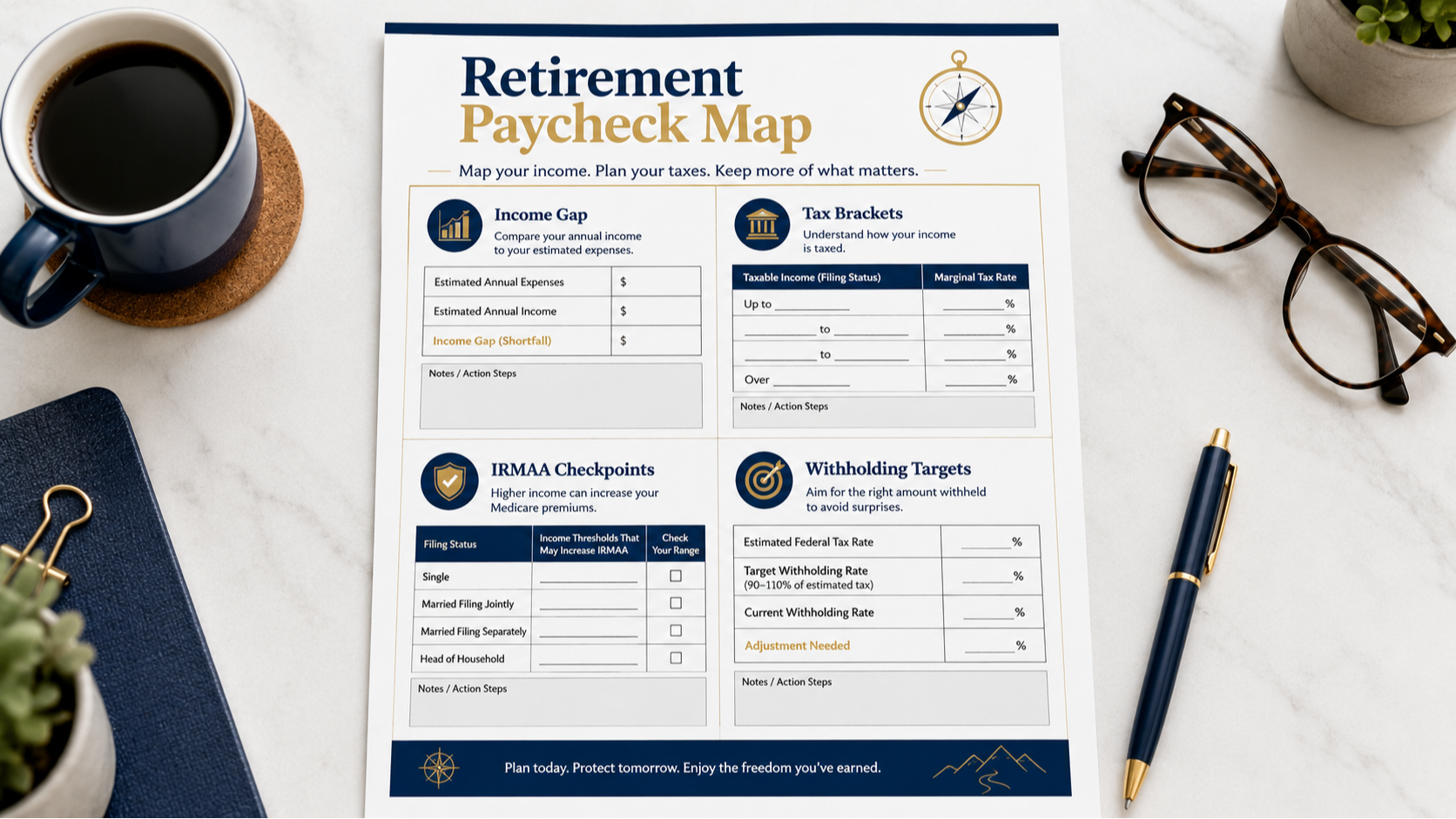
- Deliverable: A simple one-page “Retirement Paycheck Map” showing:
- Your gap and proposed account blend for the next 12 months
- Estimated withholding targets
- Key dates (RMD age, Social Security timing, IRMAA checkpoints)
- Items to revisit at midyear

Ready to retire without the guesswork?
Retiring shouldn’t feel like tax roulette. If you’re within five years of retirement (or already retired) and juggling multiple accounts, let have a conversation.
There’s no pressure to hire us. If we’re not a fit, we’ll point you in the right direction—and you’ll still walk away with clarity on your withdrawal order, withholding targets, and IRMAA checkpoints
Ready to see how a coordinated plan might fit your situation?
Get Your Retirement Paycheck MapReview our retirement planning process, how we coordinate withdrawals with taxes, Social Security, and Medicare, and what to expect when working together.